


Dana Bishop's love for the beauty and science of forest ecosystems is beyond compare. She approaches Nature with a fresh feeling of reverence and of wonder every day. Her eyes for the smallest of details (because they all add up) always amazed me - she taught me to look closer and longer, not just at the magnificence of the trees themselves, but to study the forest floor where the origin stories of forests all begin.
Food & Farming
Nature / Natural Resources
What on the Farm? Sugaring's Blue Tubing

Iconic metal buckets still collect sap for many backyard sugarers (and for our own education programs). But since its introduction in the 1950s, plastic tubing now dominates commercial sugaring operations. Shelburne Farms has had tubing for over a decade.
Still, we’re often asked: “What is all the blue tubing in the woods?” Here’s its story.
Why use tubing for sugaring?
Tubing is an efficient, less labor-intensive way to bring fresh sap from the trees to the sugarhouse for boiling into maple syrup (usually with a brief stop in a holding tank).
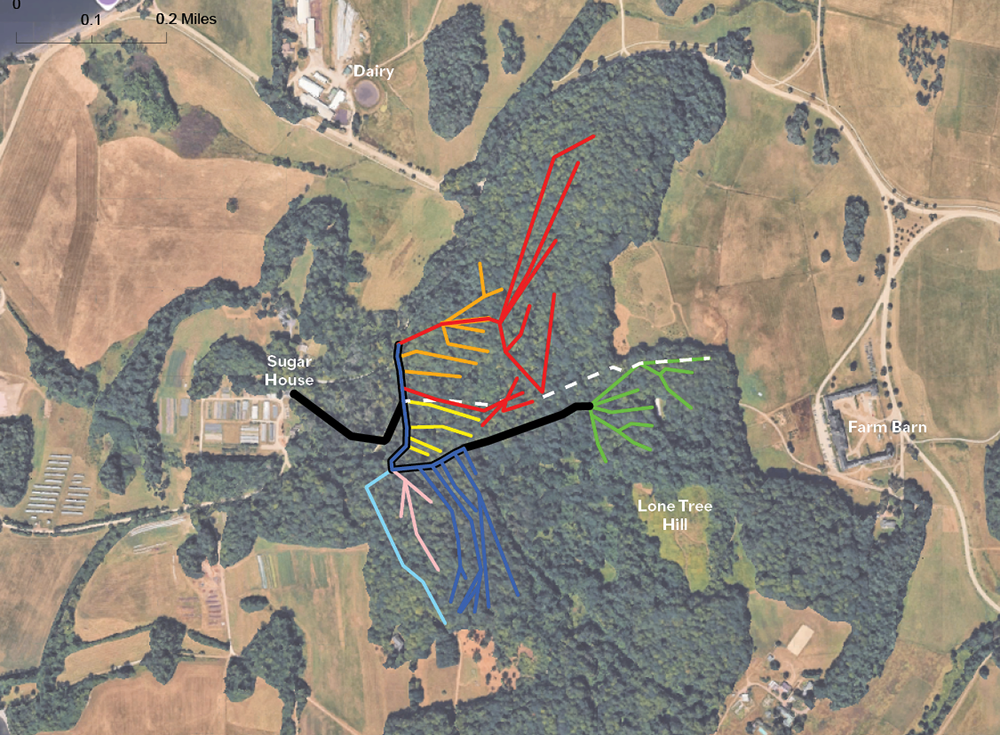
Why such a maze?
The network of tubing connects 2,600 taps set in sugar maple trees spread over 15 acres. The smaller diameter tubes, called lateral lines (ours are blue), connect to the main lines at “saddles.” The main lines (we have gray or black), feed the sap into a holding tank and ultimately to the sugarhouse.
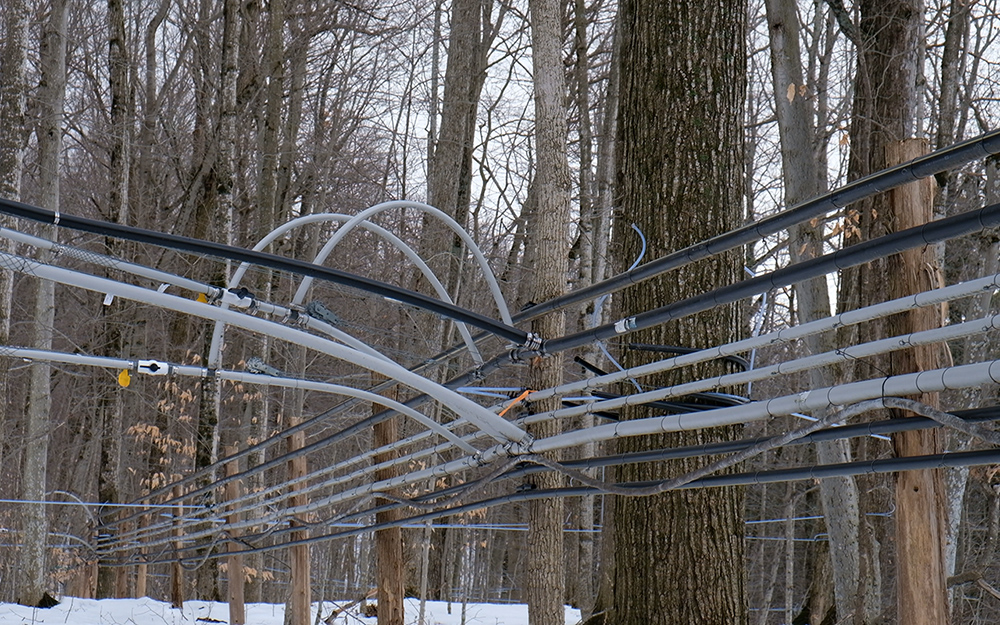
How does the sap flow through the tubing?
The main lines tilt slightly downhill so gravity helps move the sap. We also added a vacuum system that pressurizes the lines to increase sap flow. Depending on its setting, vacuum pumps can increase sap yields from 30-75%. Black tubes, as seen in the above photo, bring the pressure from the vacuum pump throughout the sugarbush.
Watch closely to see flowing sap pulse slowly through the line.
Why is so much of the tubing blue?
It’s largely about temperature. The blue absorbs enough sun to help lines thaw quickly in the morning, but not enough sun to spur much bacterial growth in the lines, so you get higher quality syrup. And it’s just easy to see and monitor in the woods. The main lines are usually gray or black.
How do you maintain the tubing?
Before the season starts, we walk the sugarbush and look for any physical damage to the lines. We’ll also straighten sagging lines, because sap can collect and freeze in the low dips, clogging the system.
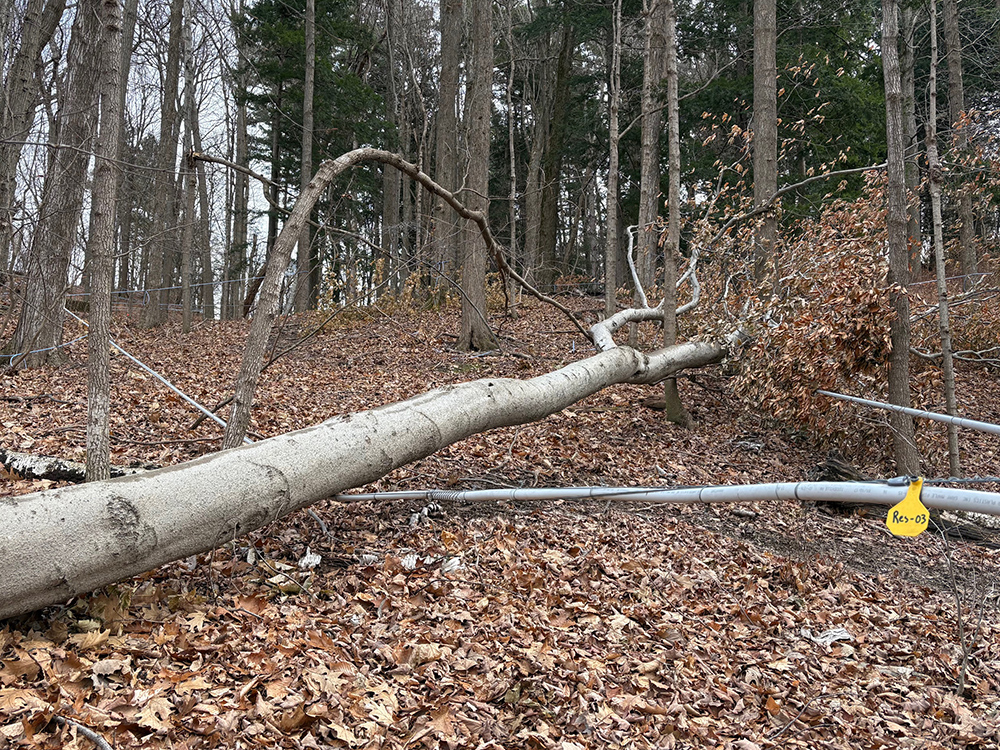
Once the sap starts running, we methodically check all of the lines for any new damage or leaks, usually from squirrels. Leaks disrupt what is ideally a closed system, dragging down sap flow. Leaks lower the vacuum pressure (less sap flow), and allow cold air in that can freeze the lines (less sap flow). A closed system lets sap flow longer into the evening, even as temperatures drop below freezing, so again, if you have leaks, you have less sap flow. The bottom line is, it’s important to stay on top of leaks!
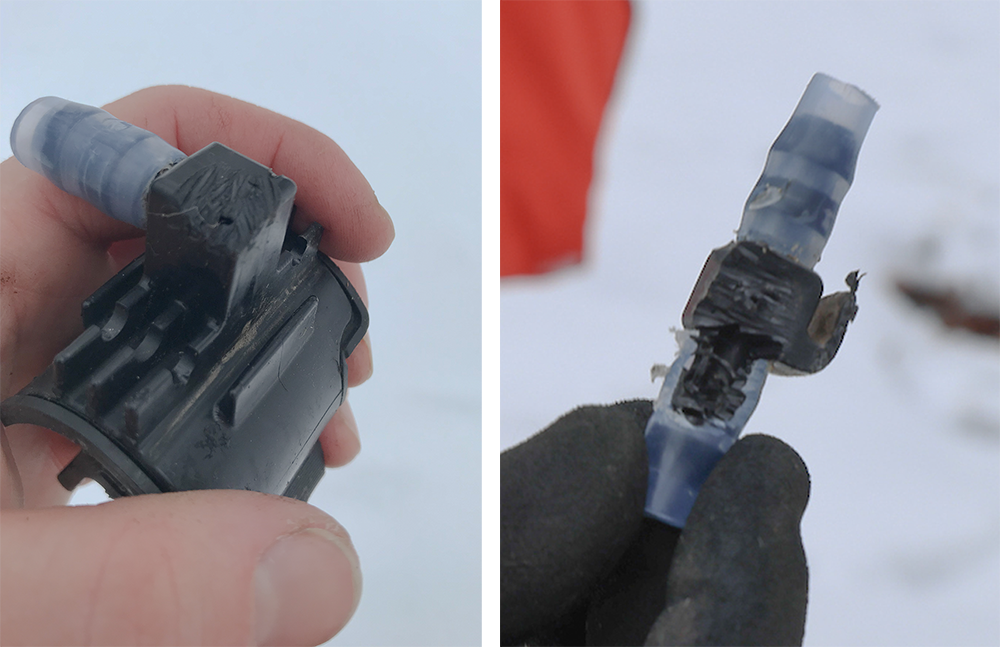
How do you find leaks?
At the start of the season, it’s all about listening for big problems. I’ll turn off a main line at a valve, wait 10 seconds, then turn it back on. If I hear a lot of air whooshing by, I know there are leaks on that line. In season, our vacuum system has sensors that detect when pressure drops in a section of line, and we can check for that on a phone app. But finding the exact leak is up to us.
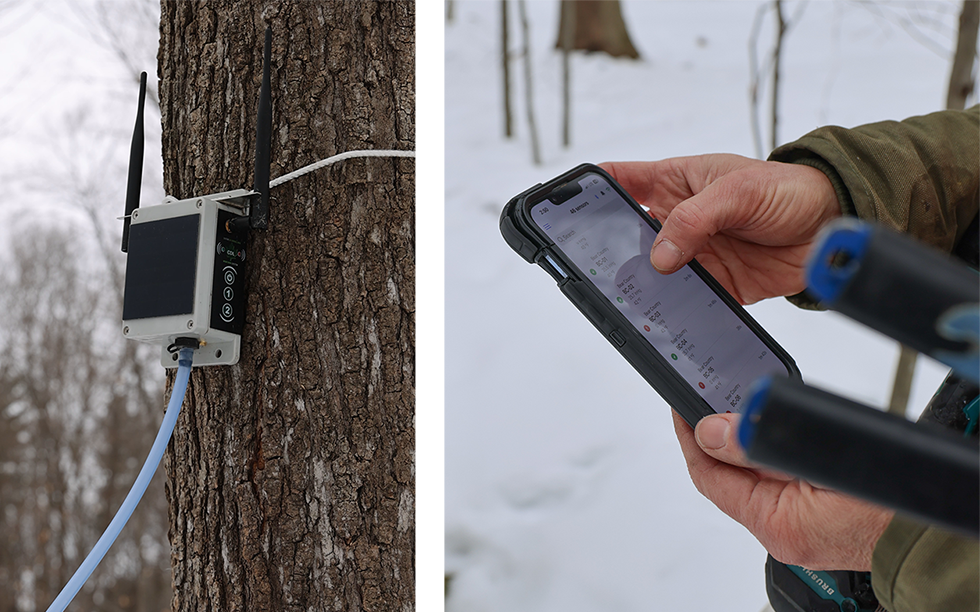
Finding a leak in season becomes more about looking than listening. A leak looks like sap and air bubbles moving really quickly in the lateral line or in a saddle. If we see that, we pinch off the line to see if the fast bubbles stop and that helps us pinpoint where the leak is.
Fast bubbling sap = a leak!
Finding a leak can drive you a bit crazy, but when you finally find it, it’s like, “Eureka!”
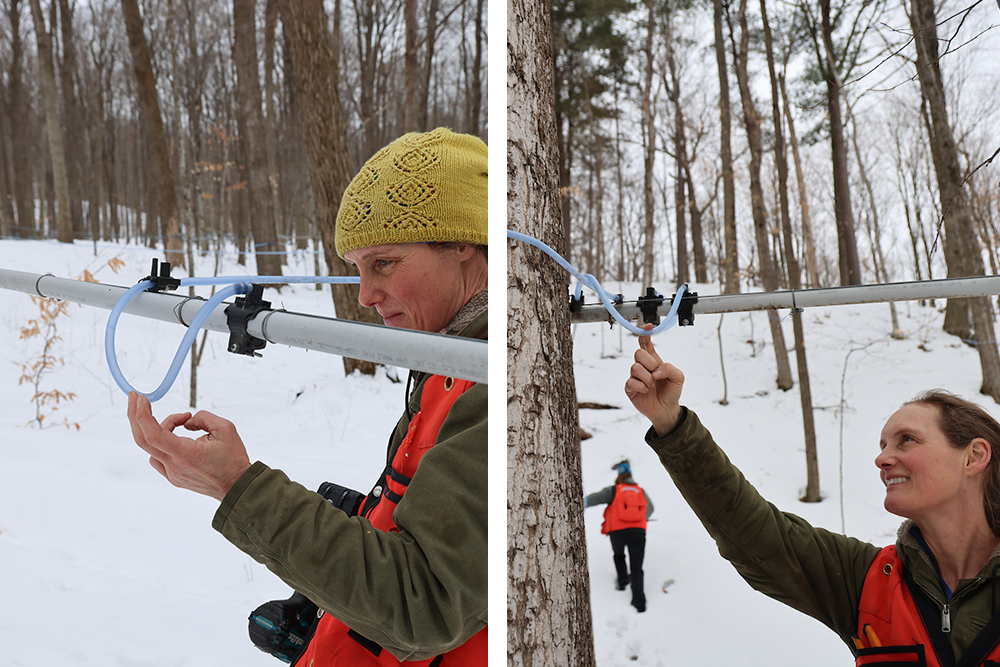
How do you fix a leak once you’ve found it?
For small leaks, we crimp out that section of line and add a new connector piece. Sometimes we’ll add a whole new length of tubing. It’s very satisfying to find and fix leaks.
Repairing a short section of tubing.
I enjoy time in the woods looking for anything that might be inhibiting sap flow. It’s a nice balance to the time inside the sugarhouse boiling sap. And I love running into walkers or snowshoers and answering their questions. Most people imagine sugaring as managing thickening syrup inside a steamy sugarhouse. I like to encourage people to look at the woods and trees (and tubing!), that makes that wonderful process possible.