
Positive Pastures

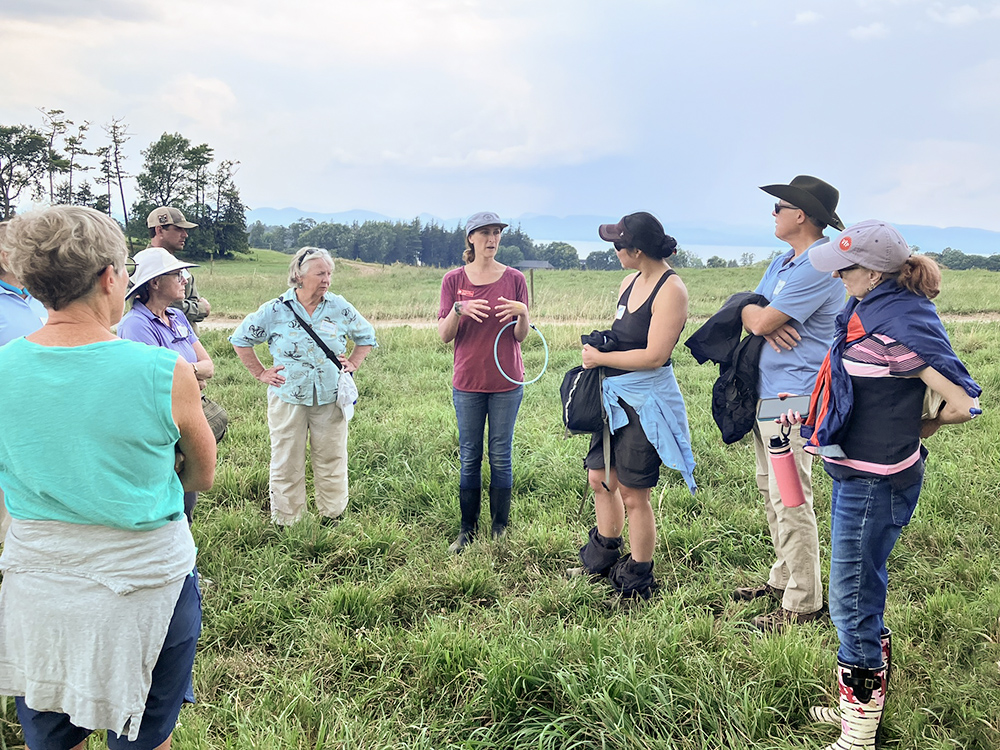
A killdeer calls once, then twice, as we ascend the cow lane. With participants in our pasture walk, we are tracing the path of the dairy herd into our grazing fields to understand what’s happening when Shelburne Farms grazes its cows.
A Long Evolutionary History
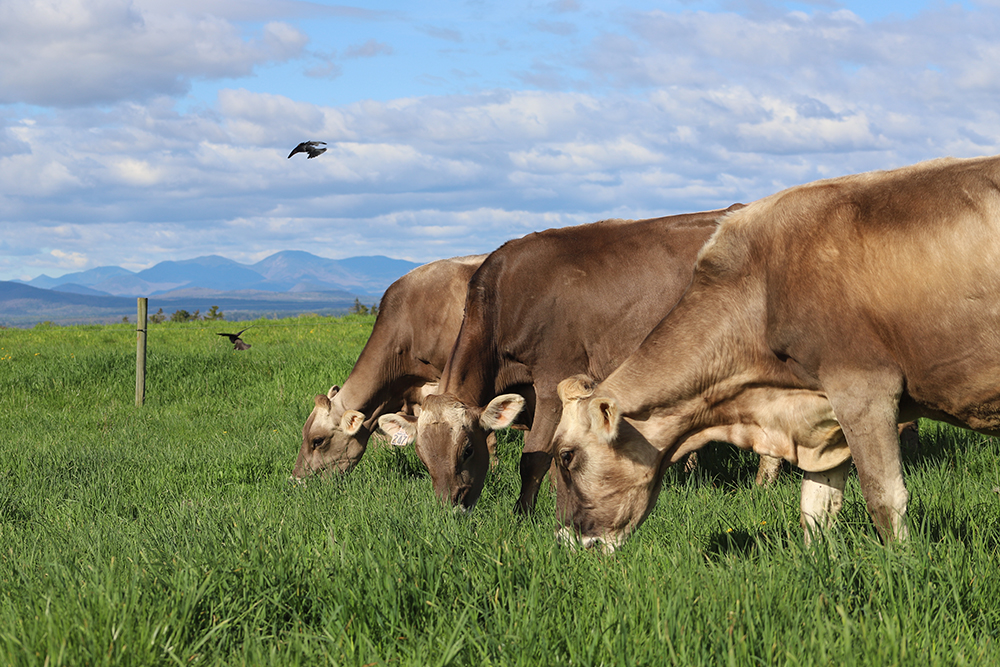
Ruminants share a long evolutionary history with grassland plants. Grasses and forbs (non-grass herbaceous plants such as dandelion, chicory, and clovers) evolved to be grazed. Their growth nodes are located low on their plant body, allowing them to not only tolerate but benefit from hungry grazers lopping off their tops. Some research has shown enzymes in grazers’ saliva may stimulate plant regrowth. In turn, ruminants, like cows, evolved to eat them and receive a variety of nutrients from the plants.
In ecosystems where grazing animals and their natural predators co-exist without farmers and fences, herds are kept on the move by predators and a constant search for fresh feed. (Picture bison herds on the Great Plains pre-colonization). This movement minimizes overgrazing (overgrazing depletes the animals’ food supply and leaves the landscape more vulnerable to drought, flooding, and erosion), and helps to spread manure and urine — vital sources of nutrients for plants — across the landscape.
Rotational Grazing: Good for the Soil and Animals
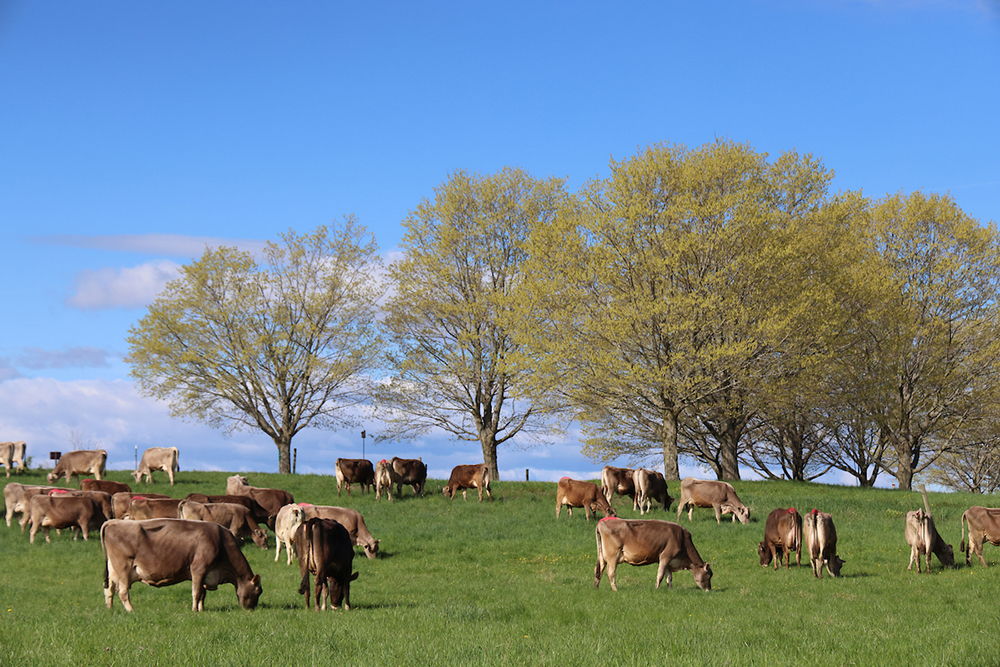
The rotational grazing system at Shelburne Farms echoes the ancestral movement of ruminants. We graze animals in small paddocks within larger pastures, then move them to fresh areas, allowing recently grazed paddocks to rest and regrow. Our farmers intuitively know how to size the paddocks based on the amount of feed they observe in the pasture, and they keep precise maps of where cows have been. How much time a pasture rests varies based on its plant species, the time of year, weather conditions, and more. When our fields are flush with grass in spring and early summer, the milking herd is moved every twelve hours! (Our beef cows and sheep also rotationally graze, though less intensively than the milking herd as the nutritional needs of a milking mother are higher.)
“This is actually the natural state for many of these animals: outside on the grass, grazing. This is where they’re the happiest,” Sam Dixon, Dairy Farm Manager says. “The air quality is the best, and the feed is the highest quality, particularly if you’re rotationally grazing, keeping them on the freshest, most nutritious grass.”
Rotational grazing offers excellent nutrition to our cows because they have access to abundant feed, and choice about what they eat — protein rich legumes like clover and vetch, or the highly digestible grasses, like the cool-season orchardgrass. In front of our eyes, cows are transforming lush pasture plants to milk and meat.
Collaborating with Sun to Store Carbon
Carbon is another chapter in our grazing story, and it begins with the sun. In the presence of sunlight, plants photosynthesize, binding atmospheric carbon with water molecules to make sugars that feed the plant’s structural parts — stems, roots, leaves. As plants grow in response to intensive grazing, some root pieces slough off, depositing carbon in the soil. Other carbon-rich roots grow deeper and more expansive to access water and nutrients, and the plant lives on.
Extensive root systems in undisturbed soil also allow insects, bacteria, and other organisms to flourish. Soil fungi “partner” with plants and microbes to serve up water and minerals to the plants in exchange for carbon that gets stored underground, while the teaming life creates channels, pathways and air pockets that give the soil structure.
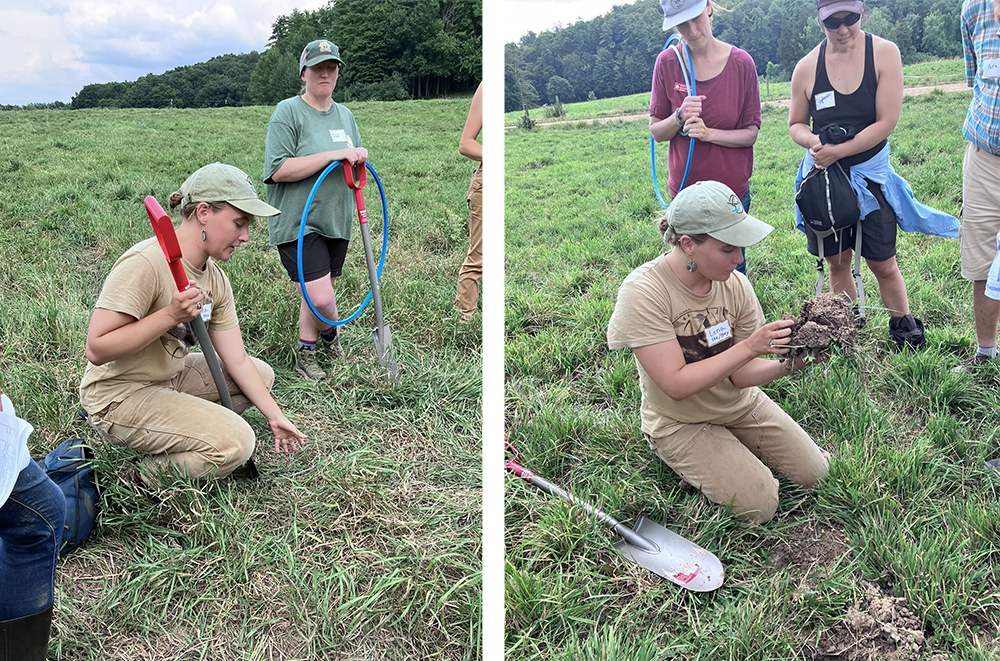
Finally, healthy mycorrhizal networks (fungal structures joining with plant roots) create “glomalin,” a sticky glue-like substance discovered relatively recently by USDA soil scientist, Sara F. Wright. Glomalin binds soil particles to create aggregates that reduce the risk of erosion and, yes, store carbon. The recent discovery of glomalin serves as a reminder of all we still have to learn about life below ground. Relationships are unfolding quietly under the hooves of our grazing herd.
The key to sustaining this underground biome is keeping our fields in perennial pasture, where plants regrow year after year without replanting. Annual feed crops, like corn or soy, must be planted each year, and that makes it more challenging for farmers to support healthy soil life, structure, and function. Averaged across the year, about two-thirds of our cows diet comes from the pasture, hay, and silage produced on our soil. The balance comes from other farms we depend on to grow grain that we purchase. (Our lamb is 100% grass fed.)
For all these reasons, grazing can be understood as a climate change mitigation strategy.
“Holding Onto Every Drop” to Build Resilience
Soil structure is also increasingly important as we experience more heavy rains and drought. Judith Schwartz, author of Cows Save the Planet, writes that water can be a nurturing element or a destructive force. Our goal is to manage our grazing to support life above and below the surface, and to ensure that rainfall, even when heavy, is a nurturing element.
For a great visual from “soil sponge strategist” Didi Pershouse, imagine pouring water over a small heap of flour. What happens? The water washes over the lump of flour, carrying a lot of flour with it and making a murky sludge. Now imagine that same flour is baked into bread, and imagine pouring the same amount of water over that bread. What happens now? The bread absorbs most of the water because life, in this case yeast, has been added.
Our pasture soils are like bread. The underground networks of life create a structure that water can slowly infiltrate, holding both water and nutrients in the soil. And deep roots hold water that can be accessed during dry periods. (Schwartz estimates that for every gram of carbon in the soil, eight more grams of water can be held in the landscape.) As Abe Collins, a Vermont-based grazing consultant and soil carbon researcher, says, “we want to hold onto every drop.”
Interdependence On the Farm and Beyond
Today around Shelburne Farms, the bobolinks have migrated for the winter, the chicory stretches toward the sun, the cow’s girth grows as her due date approaches - all made possible because of healthy soil.
Collaboration is all around us, between animals and farmers; plants and soil; nutrients and fungi. Consumers may choose to collaborate as well, supporting the healthy ecosystems that grazers and farmers maintain while enjoying nutrient dense products of these farms. Some research has found that meat from pastured cows has high levels of omega-3 fatty acids (good for brain health) and vitamin E (an antioxidant). The Vermont Grass Farmers’ has a directory of farms that raise their animals on pasture.
There are many benefits to celebrate from rotational grazing: livelihoods of farmers, habitat for grassland birds and wild animals, healthy plants for pollinators, open space, cleaner watersheds, food for local communities, and rich webs of fungal and microbial life storing carbon underground. As Robin Wall Kimmerer, a well-known Indigenous scientist, describes, pasture plants are “doing the work of the world while standing silent in the sun.” We are grateful to be part of that work.
This piece was written in collaboration with UVM Field Naturalist candidate Lena Andrews.
Learn more about our pastures on one of our daily Sun to Cheese Tours (thru Oct 18) or download this Grass fed Beef & Dairy info sheet from the Vermont Grass Farmers.


