

The Farm to School Institute is a proven professional learning model for growing robust farm to school programs that last.
Our model’s success lies in engaging whole-school teams in building shared leadership and capacity to create sustainable farm to school programs that connect the dots between classrooms, cafeterias, and communities.
Since 2015, we have been supporting states in their efforts to adapt and develop their own Farm to School Institutes, ensuring the transformative benefits are reaching more kids and realized in more communities across the country.
Adapting our model involves preserving the core components that make the Institute impactful and have staying power, while modifying how they are expressed to fit the local context. The Institute's core components represent a set of effective practices that are grounded in research and years of experience: whole-school teams, action planning, coaching, skillbuilding, and peer networking.
Our own Northeast Farm to School Institute is a program of Vermont FEED, our partnership project with NOFA-VT.
The role of the coach is essential in our model.
They provide year-long team support in creating a vision, developing an action plan, and achieving goals. We offer a nation-wide Coaching Program to deepen facilitation, leadership, and communication skills. Contact Director of Professional Development Jen Cirillo at jcirillo@shelburnefarms.org for more information. Next coaching cohort begins March 2027.
There are so many elements of this intentionally designed, thoughtful program that I want to replicate. It's just a matter of putting our own spin on it. The program has given us incredible tools, we’ve seen the model in action, and we understand why it was done the way it was done so we can adapt it at home.

Our Institute Model’s Reach
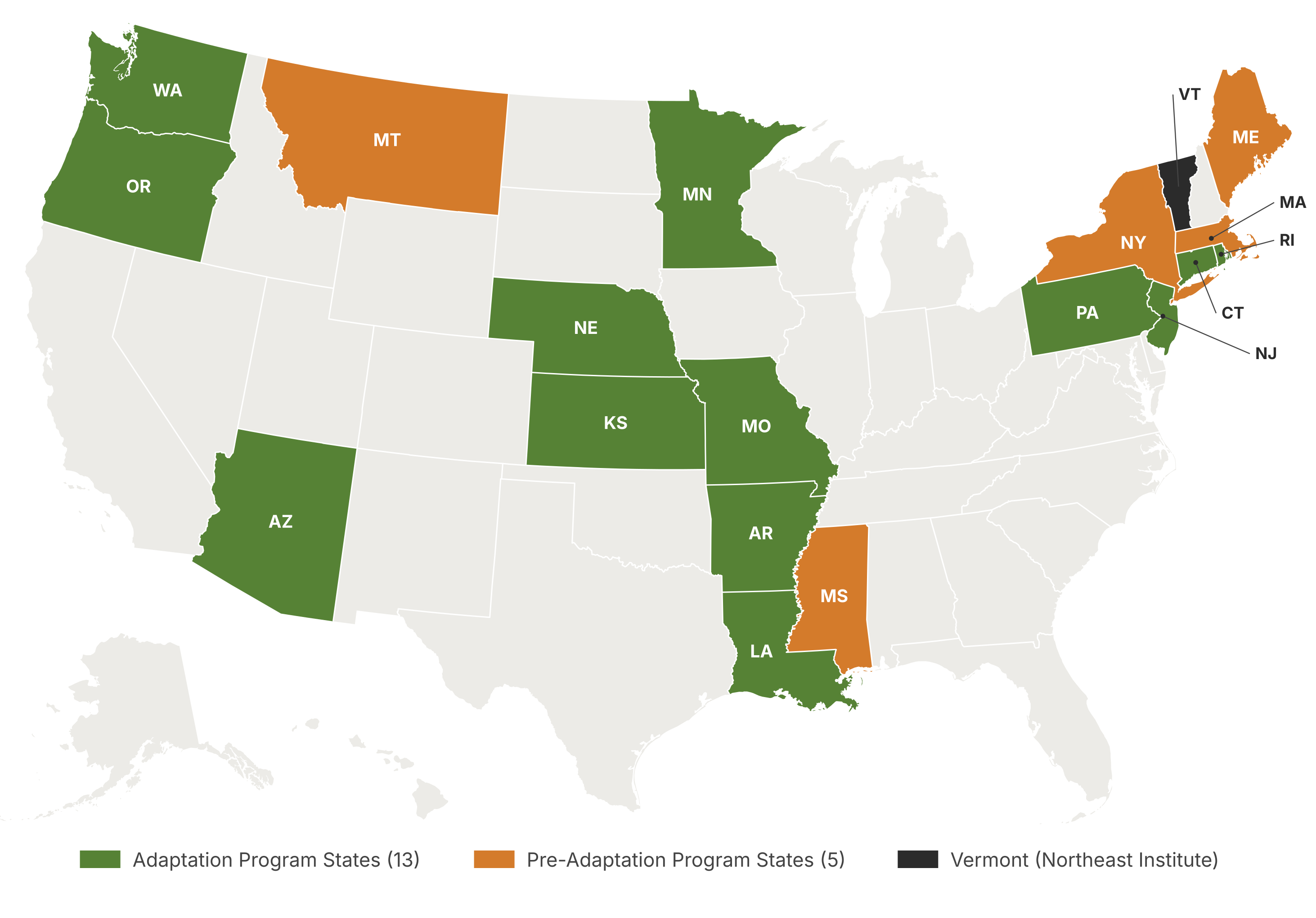
Twenty-two states joined the Adaptation Program. Thirteen of them have launched ten Institutes, which reached 155 schools, districts, and early childhood programs. Those communities together enroll about 260,000 students. The other nine states are preparing to launch.
Five pre-program states (Massachusetts, New York, Maine, Montana, and Mississippi) built Institutes before the formalized program, with support from Shelburne Farms, and have reached another 108 sites enrolling about 223,000 students.
In all, adaptation programs have reached 263 sites in communities enrolling approximately 482,000 students.
See the Model in Action
Watch how Connecticut has adapted our model to meet their state's diverse needs and goals, leading to their first statewide Farm to School Institute in 2023. Read more about their experience.
Building Relationships
Seeing and experiencing the model in action while we were in Vermont was amazing. That peer-to-peer learning was really wonderful; connecting with the other adaptation teams from Nebraska, Arkansas, and Connecticut has been invaluable.

Case Studies: Stories of Adaptation Across the Country
Across the country, states are building strong, resilient farm to school programs—many using the Institute model. These case studies highlight how states have embraced and adapted the model to meet their unique community needs, whether just getting started or now years into implementation.
Each story offers insights into collaboration, innovation, and the power of place-based adaptation:


Connect With Us
Have questions about adapting the Farm to School Institute model in your state? Reach out to Farm to School Director Betsy Rosenbluth at brosenbluth@shelburnefarms.org.
Additional Resources
- Read: Download our program brochure
- Watch: Meet program facilitators and adaptation teams as they discuss how the model has worked in their home states
- Watch: How is the model being adapted for farm to early childhood? Hear from programs in Vermont, Mississippi, Oregon, Washington, and Nebraska
- Read: Get an in-depth look at what makes the model successful