Burlington City & Lake featured on "Free Range Humans" Podcast

“What happens when learners stop simulating the real world — and start participating in it?”
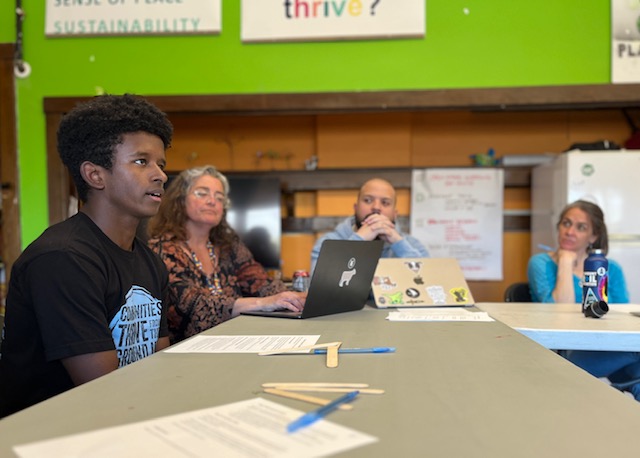
Jal Mehta and Rod Allen, hosts of the “Free Range Humans” podcast, recently spoke with Dov Stucker, co-founder and lead teacher of Burlington City & Lake Semester. The immersive place-based program, offered by Shelburne Farms and the Burlington School District to high school juniors and seniors, utilizes the city as classroom and curriculum.
As Jal and Rod describe, this is “a conversation about civic learning, public trust, and what becomes possible when students stop practicing for life and start participating in it.” Read on for excerpts, and listen to the full conversation below.
Rod: Begin with the program’s origin story. What was going on that you were seeing in schools…when you created Burlington City and Lake?
Dov: There were four co-founders, so I’m really speaking on behalf of that team, but I’ve been involved with community-based learning in various forms for a long time, and I’ve also been a classroom teacher. I believe in the experiential learning cycle. I believe that there is great power in what we learn. I believe learners are learning all the time, and that learning doesn’t need to be standardized; we can design for all kinds of learners. And I’m really compelled by the idea that the best learning is meaningful, and the only way to know that learning is meaningful is to make memories. We make memories by sharing experiences together.
Students hear all the time: ‘Oh, you’ll use this one day.’ Or, that they’re being trained for citizenship engagement later. And I’ve just always worked from a different assumption. The program is based on the assumption that students are ready for the real world now, and the real world is ready for them.
Rod: So as you and your team are creating a model that you believe is great for kids and the kinds of experiences we want and need for young people, it’s also working for the adults in the system. Would that be fair?
Dov: Absolutely. We have the luck and privilege of working both within the school system and in the real world. When we think about who the adults are who interface with our learners and learn from them and with them and act as teachers, we’re considering a community ecosystem. It’s a premise of the program, but it plays out every single day. And we see it — this idea that the most authentic decisions, the most sustainable decisions that are made by decision-makers, are made stronger with youth at the table.
The program is designed to create the conditions where young people are given a chance to weigh in, to have their insight and wisdom have real impact in city-scale decisions. And we hear back from community partners that they feel lucky to have those youth at the table. Part of this is about school redesign and rethinking school, and part of it is about creating an ecosystem that goes far beyond the walls of the classroom.
Jal: Could you tell us about a typical cycle in the program?
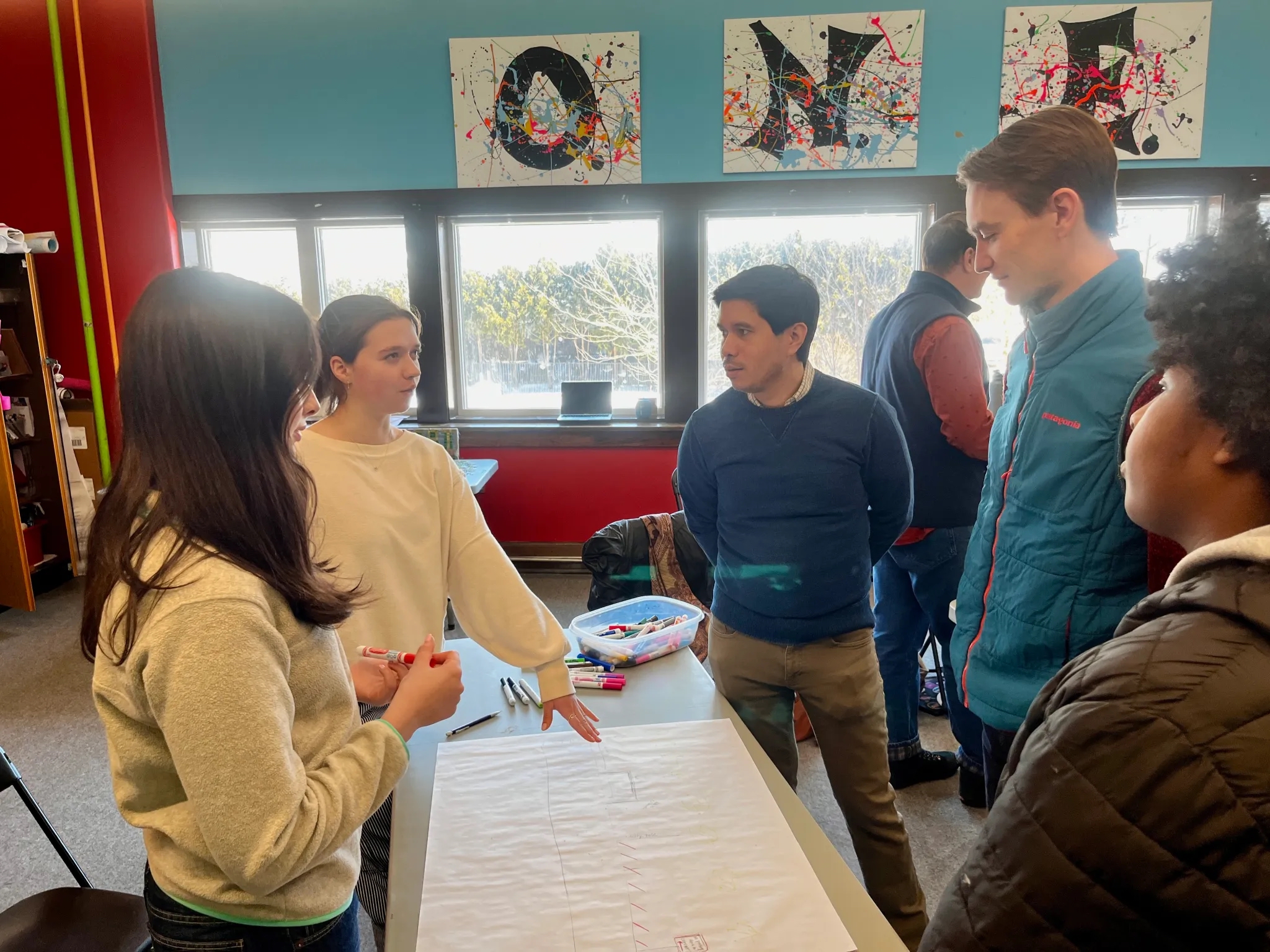
Dov: The program allows us to use the city as a classroom. We have a physical classroom outside the school, in a vibrant community center in Burlington. When students walk in the door, they’re greeted by elders, there’s a preschool in the building, there’s a community theater. So it just feels really different. This reinforces the idea that the best way to raise students as engaged citizens is to put them in a civic space. They’re with us every other day and they earn full high school credit.
The city is also the curriculum. It’s both where and what we study. We work with community partners, sometimes on-site. Often students are consulting on real-world issues and questions that the city is facing. Every semester’s learning looks different because it’s emergent, but after some initial community building and onboarding, we have a multi-week unit looking at city systems. We apply systems thinking and an inquiry mindset to understand what it takes for a city to run. We begin to discover all kinds of dilemmas, forced choices, and tough decisions. By the middle of the semester, we’ve invested in learners as consultants. They’re ready to weigh in and meet community partners, whether nonprofit leaders or business leaders, people from the arts community, and city departments.
Students consult on real-world issues. One example from a few years ago, we saw a spike in homelessness and the extreme margins of the housing crisis in our city. We began to see more encampments on public land. Our students brought together leaders from nine different organizations, agencies, and city departments to have a conversation that they weren’t having about how to balance values in public space, about how to balance conservation and recreation, while also considering social justice.
We’ve been able to respond to whatever is called for in our city. In the fall of 2020, our students were embedded with the Burlington Police Department, helping them to think about police practices. So whatever is alive in the city or historical moment, we can lean into.
Jal: What would you say to a prospective teacher who is listening to this and thinking, I’m interested in doing something like that, but it sounds like a huge lift to get going?
Dov: I have two answers. One is that replication is not the goal, right? We are as authentically place-based as we can be. My definition of place-based education is actually quite simple. It’s, what can we do right here, right now, that we couldn’t do anywhere else at any other time? And what can we do with this group of people that we couldn’t do otherwise? Any educational experience or learning environment that answers those questions is place-based.
And the other answer is, although I would love to help anyone who wants to get a fully-fledged semester program off the ground, I believe in making learning more authentic, more mutually-empowering, and more transformational — whether or not it’s a fully-fledged program. You don’t need a full semester program in order to add more relevance to the curriculum, or to work with community partners as an authentic audience, or to invest in community-building so that learners will take more risks. All those elements and more are fully replicable, even if Burlington City & Lake might not be. And that’s by design. If you were to take anything we do and take it to a different place, it should be different.
It’s also worth underlining the power of partnerships. We work with an organization, an amazing nonprofit called Shelburne Farms. They are a world leader in Education for Sustainability, professional development, place-based learning. Some of that is a funding partnership, but we also share the same mission. So think about public and nonprofit partnerships.
Rod: You mentioned a really important, pivotal partnership with Shelburne Farms. What other partners do you want to highlight?
Dov: The BCL program happens to be in either a big town or a small city, depending on your definition. And Burlington functions in this beautiful way. It’s part of why we could pilot this initiative here. It’s big enough that there is more going on than we could ever learn, study, or touch, but it’s small enough that you can make a cold call to anyone. This allows us to work with community partners every day.
Place-based learning, as most people understand it, it’s sitting in the woods around a campfire. But if you live in a city, the question is what can you do only here?
“Free Range Humans” is a podcast hosted by Jal Mehta, professor at the Harvard Graduate School of Education, and Rod Allen, former district superintendent and Assistant Deputy Minister with the BC Ministry of Education.
Support BCL Today
Shelburne Farms is the lead community partner in this innovative semester-long program because we believe in the power of transformative education to create a sustainable future. Please help us reach our annual $100,000 goal for this project by donating today.
Partners