
Strength in Numbers

At September’s Climate Education Collaborative Summit, educators and other leaders unite to move vital work forward
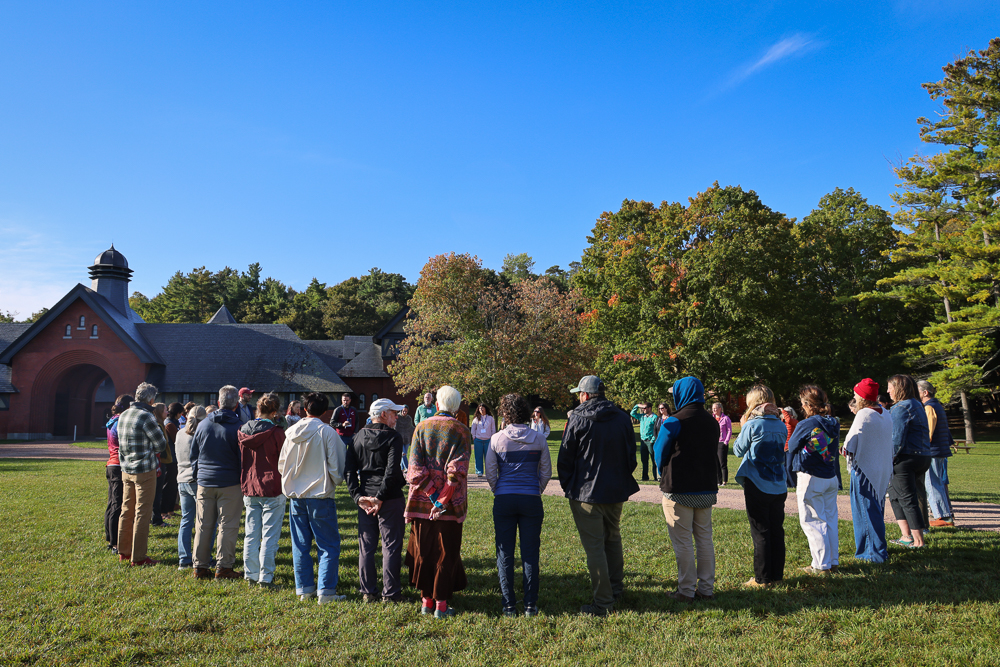
Under a bright blue sky and warm sun, sixty people stand in a circle in front of Shelburne Farms’ Coach Barn. The leaves on nearby trees have just begun to turn golden and red, and a loon calls from the lake. In this moment, it’s not hard to summon gratitude and awe for our planet. And that’s how the Climate Education Collaborative’s Summit started: with an acknowledgement of the land and all it provides for us, a reminder of what every person in this circle is working to save.
The Summit gathered young people, educators, and other leaders from across the Northeast for two days of conversation, connection, and learning. On the national stage, progress on climate may seem stalled. But the Summit was a reminder that in our region, climate education is moving forward, in classrooms and capitol buildings, in cities and rural communities. Opportunities like the Summit help strengthen these efforts.
-

Workshops included opportunities to explore art as a form of climate expression and activism. Here, an attendee’s piece entitled “Ripples: Every action creates a ripple that spreads,” made during a session facilitated by Bow Seat’s Susan Tang and Shelburne Farms’ Aimee Arandia Østensen.
-
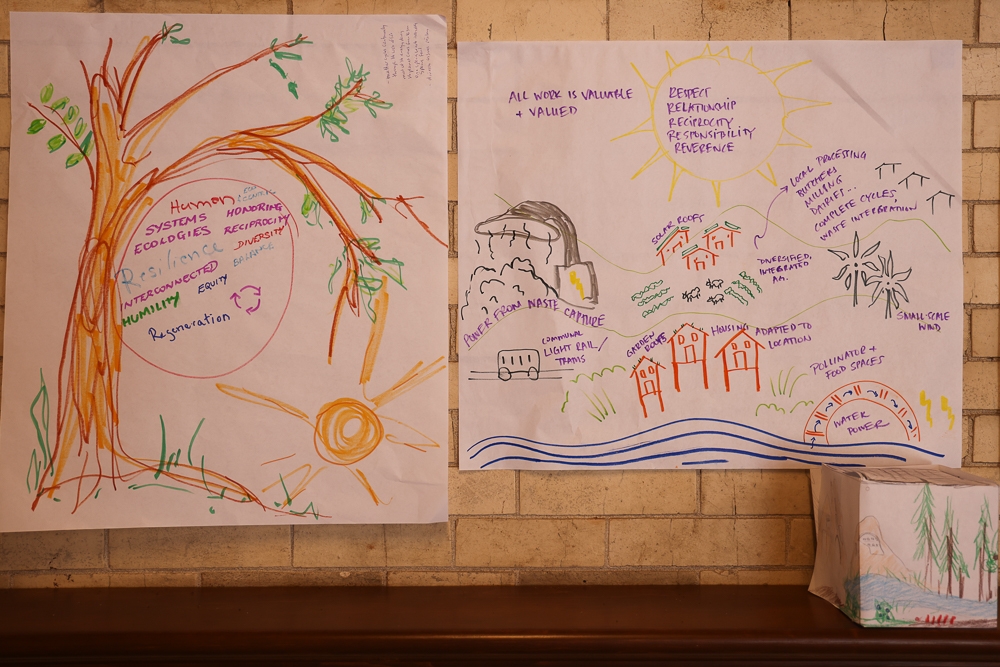
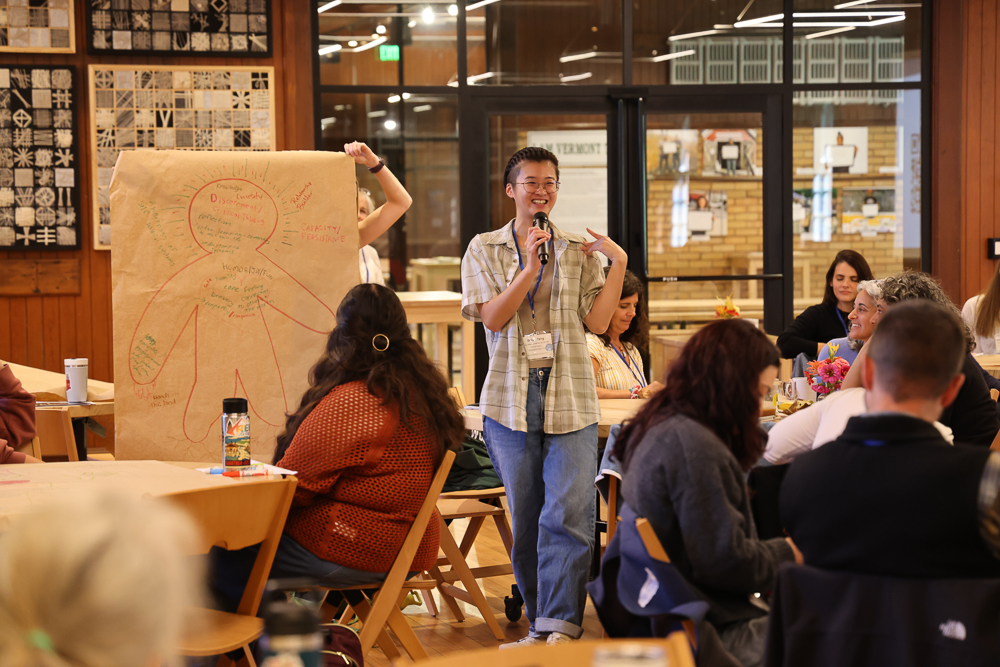
Groups sketched their visions of a climate-resilient future in a workshop with Shelburne Farms' Jen Cirillo and National Wildlife Federation's Liz Soper. Students who attended the workshop from Harwood Union High School have already adapted this activity for their Sustainability Club.


One big example came from New York, where every school district—encompassing approximately 2.2 million students and 210,000 teachers—is now required to teach about climate change’s causes, impacts, and solutions. The mandate just passed this spring after “years, and a lot of tears,” thanks to a coalition of thousands of dedicated young people and educators, said Joe Henderson, a policy advisor to the state who also researches climate education at Colgate University. Climate literacy is now part of the state’s graduation requirements, making it a key part of preparing students for the future.
Students pushed for a similar statewide climate education standard in New Hampshire. Although the effort, led by youth involved with 350NH, stalled in the legislature in 2024, the experience made a lasting impact on these young leaders, said Sophia Donforth, Executive Director of the Vermont/New Hampshire Energy Education Programs. “These students recently told me, ‘I learned I can show up and that people will listen. And that’s a muscle I’ve been flexing ever since.’”
Mandates, clearly, aren’t the answer for every state. Stories were plentiful of young people and educators forging new pathways to access climate education. A “huge, growing constellation of organizations outside of the traditional K–12 school system” is working to push the needle, shared Donforth. Said Jen Cirillo, director of professional learning at Shelburne Farms Institute for Sustainable Schools, “I don’t think curriculum [mandates] change practice. That’s where community partners play a really important role in helping teachers reflect on and improve and change their practices.” In Vermont, students are actively working with teachers to offer courses on sustainability and climate. “I see such a deep commitment from educators in the state who care deeply about the young people in their classrooms and communities, whether it’s learning about climate change or gaining other real-life, hands-on experiences.”
Among the teachers in attendance at the Summit was Jeannie Kornfeld, who led the development of the nation’s first student-driven climate action plan for a high school at New Hampshire’s Hanover High School. The plan was adopted by the entire school district in 2025. Also from the Upper Valley region of Vermont and New Hampshire were three teachers—Janis Boulbol, Abbie Castriotta, and Kat Robbins—who lead Woodstock Union High School’s CRAFT program, short for Community and Climate Resilience Through Agriculture, Forestry, and Technology. CRAFT students take courses including Economics and the Environment, Regenerative Agriculture, and Eco Art. To date, 26 students have graduated with the CRAFT certification, and another 72 are currently enrolled.
A youth-led campaign established the Maine Green Schools Program last year to support public schools in advancing sustainability. A distinctive element of climate education in Maine, said Green Schools’ director Glenn Cummings, is that all schools are required to teach Wabanaki Studies, providing an opportunity to braid western science and Indigenous knowledge. “All of what we teach in climate change education would not be there without Traditional Ecological Knowledge.”
At small tables throughout the Coach Barn’s West Hall, educators worked together to illustrate portraits of “climate stewards,” depicting the qualities, skills, and knowledge that all of us need to cultivate. There were some variations—a few groups mentioned humor, joy, and fun, for example—but most emphasized similar qualities, including discernment, collaboration, caring, adaptability, and respect. Central to every drawing? A big heart.
The Climate Education Collaborative encompasses 200+ organizations and individuals collaborating to support systems-level change for climate action, justice, and education, and is supported by Shelburne Farms.


